Your AI agents need tools. Those tools live on MCP servers, and someone has to build, deploy, secure, test, and publish those servers before an agent can use them in production.
An April 2026 audit of 2,181 remote MCP endpoints found that 52% were completely dead and only 9% were fully healthy. Getting a server live is the easy part. Keeping it healthy and passing ChatGPT and Claude review is where teams get stuck.
This guide compares the eight platforms teams evaluate most often for deploying MCP servers in 2026, including where each falls short.
TL;DR
- Manufact (formerly mcp-use) is the most complete option for teams building, deploying, testing, and publishing their own MCP servers and apps: GitHub deploys, an embedded Inspector, cross-client test suites, MCP-native analytics, and automated publishing checks for the ChatGPT Apps Store and Claude Connectors.
- Cloudflare Workers is the strongest raw infrastructure play, with the deepest OAuth tooling and a hosted playground, if you're willing to assemble testing and analytics yourself.
- Vercel makes sense when your MCP server lives inside an existing Next.js app and you already deploy there.
- Smithery (now part of Arcade) is a registry and distribution layer for getting your server discovered, more than a place to run it.
- MintMCP is an enterprise gateway for governing which agents touch which tools, aimed at IT and security teams rather than builders.
- Stainless generates an MCP server from your OpenAPI spec; you host it elsewhere.
- Zapier MCP is a no-code hosted gateway to 9,000+ existing app integrations, with no way to deploy your own code.
- MCPHosting.io is free and simple, with almost no public documentation.
All of these can serve MCP traffic. They differ in how much of the lifecycle they cover after the server is live.
What is an MCP deployment platform?
The Model Context Protocol (MCP) is the open standard that lets AI clients like ChatGPT, Claude, and Cursor call external tools. An MCP server exposes those tools over a remote endpoint.
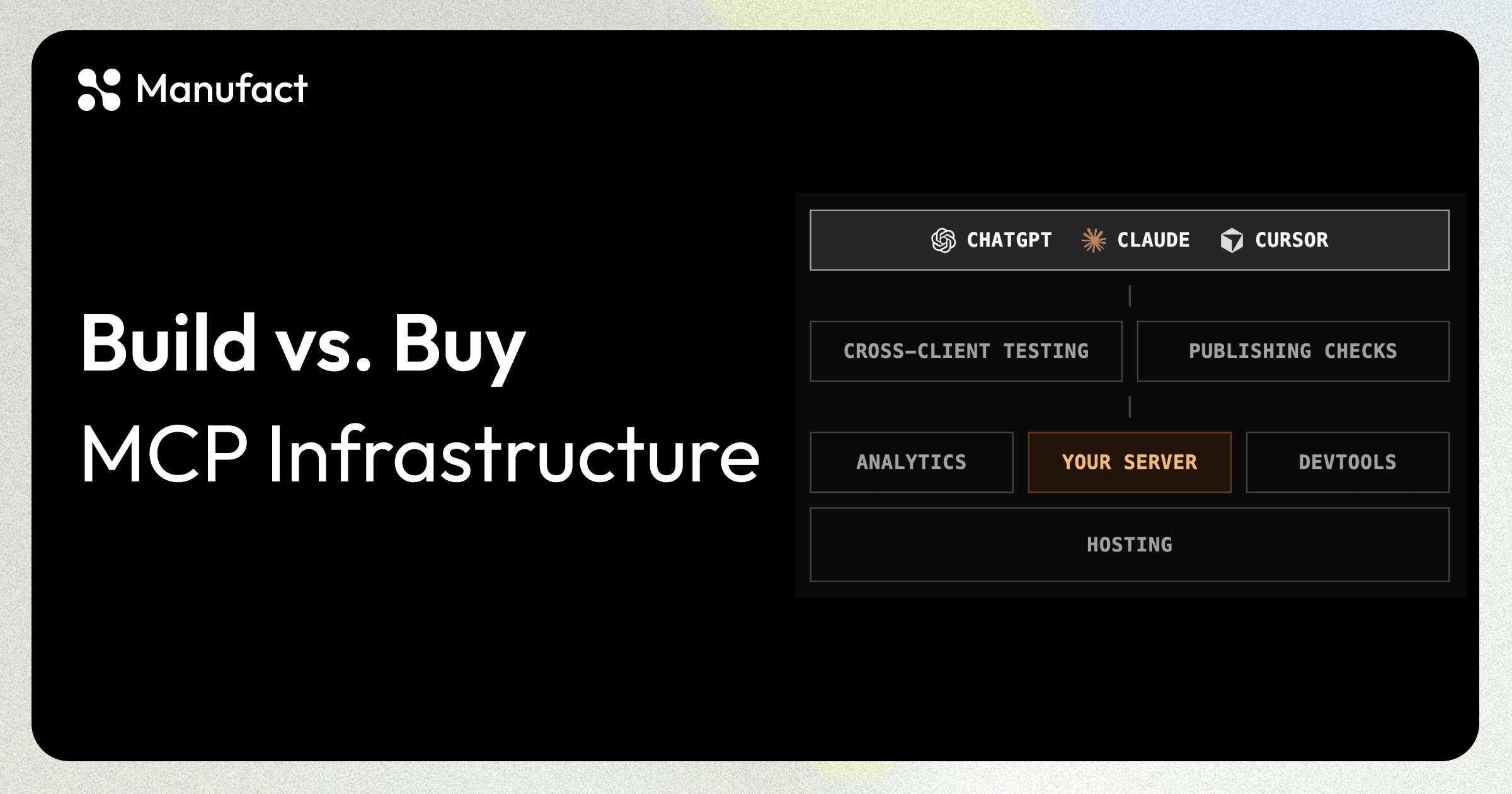
A deployment platform, in the narrow sense, runs that endpoint for you. In the sense that matters in 2026, it also covers what comes after: verifying tools behave the same across clients, watching which tools get called and which fail, handling OAuth for end users, and clearing the review bar for the ChatGPT Apps Store and Claude Cloud Connectors.
What to look for
Six criteria separate the platforms below:
- Language support. Some platforms deploy TypeScript and Python, some one of them, some only what a generator emits.
- Testing. A documented way to invoke deployed tools programmatically, run test suites across clients and models, and gate CI on the results.
- MCP-native observability. Tool-call counts, error rates, latency percentiles, and client breakdowns, rather than generic request logs.
- Auth. Managed OAuth for end users versus a library you integrate yourself.
- Publishing. Automated checks against ChatGPT and Claude store requirements.
- Developer workflow. GitHub deploys, preview URLs per pull request, a CLI, and an API an agent can drive.
Most platforms cover two or three of these well.
The platforms
1. Cloudflare Workers: edge infrastructure with the deepest OAuth toolkit
Cloudflare was the first major platform to support remote MCP servers, back in March 2025, and the infrastructure story remains excellent. Servers deploy globally to the edge via a "Deploy to Cloudflare" button (which wires up a GitHub repo with auto-deploy) or the Wrangler CLI. Durable Objects give you stateful, per-session servers. The workers-oauth-provider library turns your Worker into a spec-compliant OAuth 2.1 server, and the AI Playground doubles as a hosted remote MCP client for manual testing.
What stands out: The blog post claims a production deploy "in less than two minutes." Branch preview URLs post to PRs. OAuth tooling is the most complete of any platform here, including third-party integrations with Stytch, Auth0, and WorkOS. The free tier gives 100,000 requests per day; the paid plan is $5/month.
Where it falls short: TypeScript only. Analytics are generic Workers metrics with no tool-call, client, or per-tool latency dimensions. There are no publishing checks, no test suites, and no programmatic way to invoke deployed tools (the docs recommend running evals but ship no tooling for them). The original McpAgent class is deprecated mid-migration to MCP SDK v2, so templates and docs are currently in transition.
Best for: Teams with infra experience who want maximum control at edge scale and will build their own testing and observability.
2. Manufact: the full-lifecycle MCP platform
Manufact (formerly mcp-use) is built by the team behind the open-source mcp-use SDKs for TypeScript and Python (7M+ downloads, 10k+ GitHub stars) and the open-source MCP Inspector. It's the only platform in this list that covers deployment, testing, observability, and store publishing in one product.
What stands out: Deploys run through a GitHub App (push to deploy, watch paths, wait-for-CI), a CLI (npx mcp-use deploy), or Manufact's own MCP server, so an agent can drive the platform end to end. Every branch gets a preview URL per pull request. The claim is under 60 seconds from git push to live. TypeScript, Python, FastMCP, and Dockerfile presets are all supported, or you can connect an existing server by URL.
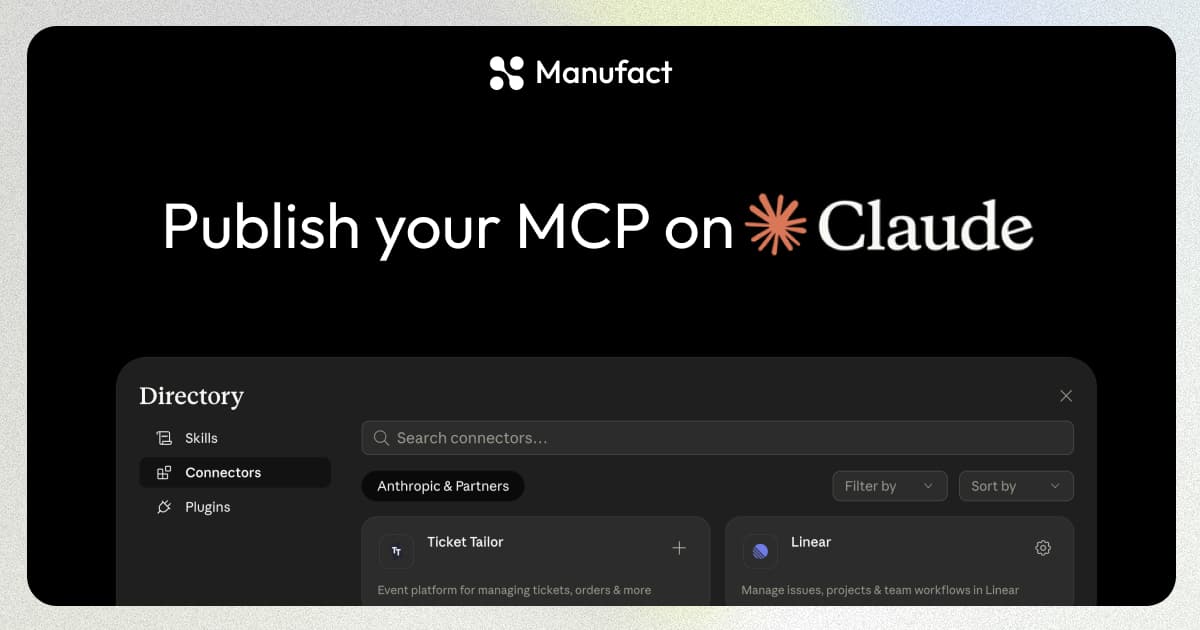
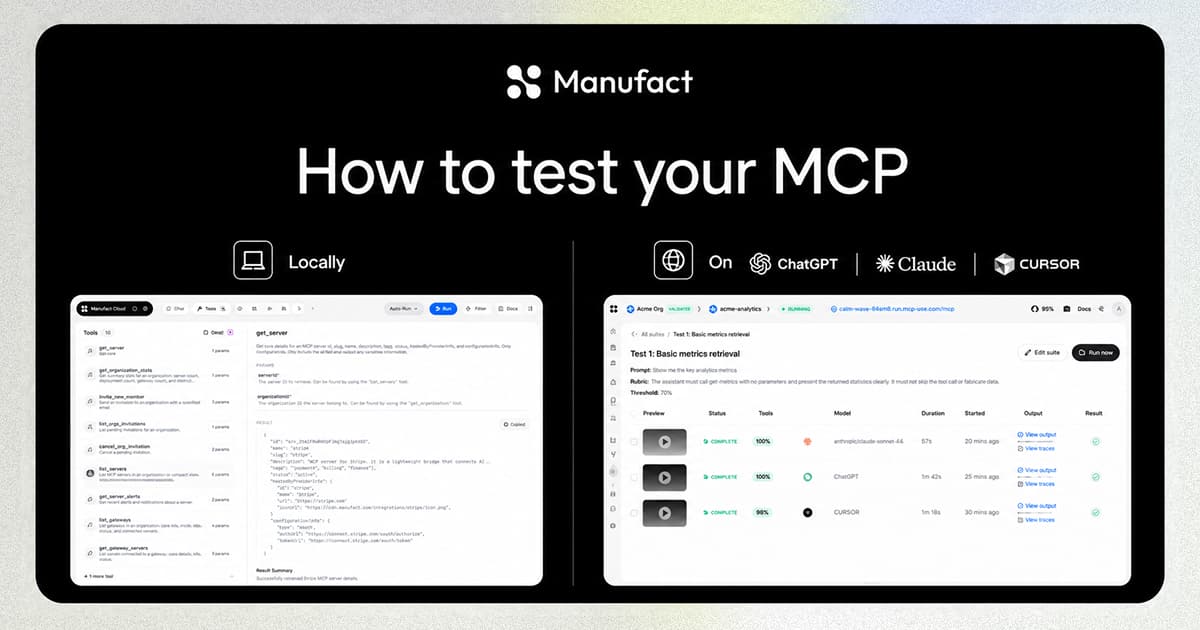
The embedded Cloud Inspector runs your server against real clients with no local setup. Test suites exercise tools across clients and swap models between GPT, Claude, and Gemini, with LLM-judged results that can block a merge in CI. E2E publish checks run your server live inside ChatGPT and Claude and verify tool calls and widget rendering. Six categories of publishing checks (protocol and discovery, tool conformance, security and policy, metadata, domain/TLS/CSP, assets) map to ChatGPT Apps Store and Claude Connectors requirements, each with fix guidance and an autofix flow, plus a generated submission pack. Analytics are MCP-native: tool calls, sessions, error rates, p50/p95/p99 latency per tool, client and protocol-version breakdowns, geography, token counts, and session replay. OAuth ships with six documented providers (Auth0, Better Auth, Clerk, Keycloak, Supabase, WorkOS).
Considerations: Test suites currently run against Inspector and ChatGPT, with Claude and Cursor listed as coming soon. Preview deployments, E2E checks, and the submission pack require the Hobby plan ($25/month) or higher, and multi-region deploys require Startup. The free tier includes $5/month of usage credits and 7-day analytics retention.
Best for: Teams whose product is the MCP server or MCP app itself, especially anyone shipping to the ChatGPT Apps Store or Claude Connectors.
3. Vercel: MCP as a route in your Next.js app
Vercel treats an MCP server as another route in your web app. The mcp-handler package mounts a server in Next.js, Nuxt, SvelteKit, or any Fetch-compatible framework, and the standard Vercel workflow applies: git push, preview deployment on every PR, instant rollback. Fluid compute fits MCP's traffic shape of long idle stretches and short bursts.
What stands out: If your team already deploys on Vercel, adding an MCP endpoint costs an afternoon. Preview deployments work on every plan, including the free Hobby tier. withMcpAuth and the protected-resource metadata handler track the current MCP auth spec, including the shift to Client ID Metadata Documents.
Where it falls short: JavaScript/TypeScript only. There is nothing MCP-specific beyond the handler: no inspector, no registry, no publishing checks, no tool-level analytics, and no programmatic post-deploy testing. Vercel provides the resource-server side of OAuth; you bring your own authorization server. Hobby is limited to non-commercial use, and Pro starts at $20 per developer per month.
Best for: Web teams adding MCP to an existing Vercel app who plan to assemble testing and observability elsewhere.
4. Smithery: registry and distribution, now part of Arcade
Smithery joined Arcade.dev and has refocused on being the place MCP servers get discovered and connected, with 14,000+ servers listed. You can publish any Streamable HTTP server by URL regardless of language, and Smithery layers managed OAuth, scoped service tokens, and typed per-server SDKs on top. A solid CLI (smithery tool call) and REST API let you invoke tools on any connected server programmatically.
What stands out: Distribution. A server page where users can discover, try, and install your MCP from any client, plus publishing validation (metadata scanning, an OAuth-behavior check, a vendor verification checklist, and a security status per server). Managed connection auth is strong.
Where it falls short: Smithery-hosted runtime is limited to JavaScript module uploads; everything else is bring-your-own-hosting via URL. GitHub-connected deploys are no longer documented. No preview deployments, no E2E testing, no cloud playground with selectable models, and analytics are limited to tool-call counts and runtime logs.
Best for: MCP vendors who already host their server and want discovery, managed auth, and a distribution channel.
5. MintMCP: the enterprise gateway for agent governance
MintMCP answers a different question: how does an IT organization control which agents reach which tools? It's an MCP gateway with SSO (SAML/OIDC), SCIM, per-agent identities, prompt-injection guardrails, tamper-proof audit logs with SIEM export, SOC 2 Type II, and HIPAA alignment. Hosting your own server is supported through a CLI and Docker images, with health checks before traffic swaps and rollback on failure.
What stands out: Governance depth no one else here matches. Usage analytics cover users, tokens, cost, model mix, and per-harness filters (Claude Code, Cursor, Copilot, and others). The Admin MCP lets an agent drive deployments conversationally. Customers include Coursera, Braze, and Stability AI.
Where it falls short: It's a gateway first and a deployment platform second. No public registry, no publishing checks for consumer stores, no embedded inspector, no PR previews, no test suites. GitHub-connected deploys aren't documented (the CLI packages your local directory). Pricing is custom-quote only.
Best for: Enterprise IT and security teams putting internal MCP usage under one governed roof.
6. Stainless: generated MCP servers from your OpenAPI spec
Stainless generates SDKs from OpenAPI specs for companies like OpenAI, Anthropic, and Cloudflare, and it can now generate an MCP server as part of your TypeScript SDK. The output is clever: a dynamic-tools mode that keeps large APIs under client tool limits, automatic jq filtering to cut context usage, and per-client schema adaptation for Claude, Cursor, and OpenAI agents.
What stands out: If you have a large, well-specified API, this is the fastest path from spec to a capable MCP server, with preview builds on every PR that touches the spec. The generated Cloudflare Worker can act as its own OAuth server for APIs without one.
Where it falls short: MCP generation is explicitly experimental and TypeScript-only. Stainless doesn't host anything: you publish to npm or deploy the generated Worker yourself, and testing means running the local Inspector by hand. No analytics beyond an X-Stainless-MCP header you can segment in your own systems.
Best for: API-first companies that want an official MCP server derived from the same source of truth as their SDKs.
7. Zapier MCP: 9,000 apps behind one hosted server
Zapier MCP is a fully hosted MCP server exposing Zapier's 9,000+ app integrations and 40,000+ actions as tools. Setup is a dashboard flow with no code, and Zapier handles OAuth, credentials, and rate limiting for every connected app. Enterprise controls include SAML SSO and SOC 2 Type II.
What stands out: Breadth. If the tools your agent needs are Gmail, Slack, HubSpot, and Sheets, setup takes under five minutes. 195,000+ MCP servers have been created on it.
Where it falls short: You cannot deploy your own code, and you cannot bring in third-party tools. Every successful tool call consumes 2 tasks from your Zapier plan (test calls included), which gets expensive at agent volumes. Data residency is US-only, the product is still labeled Beta, and analytics amount to an activity log.
Best for: Non-technical teams and quick internal agents that need existing SaaS actions rather than custom tools.
8. MCPHosting.io: free and simple, with thin documentation
MCPHosting.io offers free serverless hosting for Python FastMCP and Node.js servers with GitHub-connected deploys ("push a commit, get a new build; open a PR, get a branch deployment"), built-in OAuth, and MCP-aware analytics showing request/response pairs and tool usage.
What stands out: A free tier with sub-second cold starts and zero config, a fine on-ramp for side projects.
Where it falls short: There is effectively no public documentation: no docs site, no CLI or API reference, no published paid pricing, and no compliance information. Every claim above comes from a single marketing page. Until the docs exist, that rules it out for production use.
Best for: Hobby projects and experiments where free matters more than support.
Quick comparison
| Capability | Manufact | Cloudflare | Vercel | Smithery | MintMCP | Stainless | Zapier | MCPHosting.io |
|---|---|---|---|---|---|---|---|---|
| Deploy your own code | Yes | Yes | Yes | JS upload / URL | Yes | Generates only | No | Yes |
| Languages | TS, Python, FastMCP, Docker | TS | TS | JS (hosted) | TS, Python, Docker | TS | N/A | Python, Node |
| GitHub deploys | Yes | Yes | Yes | Not documented | Not documented | Release flow | N/A | Yes |
| PR preview URLs | Yes | Yes | Yes | No | No | Builds only | N/A | Claimed |
| Embedded inspector | Yes | Playground (separate) | No | Server page | No | No | No | No |
| Cross-client test suites | Yes | No | No | No | No | No | No | No |
| Store publishing checks | 6 categories + autofix | No | No | Registry checks | Private store only | No | No | No |
| MCP-native analytics | Tool calls, errors, p50/p95/p99, clients, geo, replay | Generic | Generic | Calls + logs | Gateway usage/audit | Header only | Activity log | Claimed |
| Managed end-user OAuth | 6 providers | Provider library | Resource side only | Managed | Full SSO/SCIM | Config/generated | Fully managed | Built-in |
| Free tier | $0 + $5 credits | 100k req/day | Hobby (non-commercial) | Hobby | Trial only | 5 generators | ~50 calls/mo | Yes |
How to choose
Route by what you're shipping. Teams building on their existing edge infrastructure, with the engineers to assemble testing and monitoring, are hard to move off Cloudflare Workers. When MCP is a feature of an existing Next.js app, use Vercel. Governance over agents consuming tools inside a large org points to MintMCP. Zapier covers existing SaaS actions with zero code. An OpenAPI spec plus Stainless produces a strong generated starting point that you then host elsewhere.
If the MCP server or MCP app is the product, and you care how it behaves inside ChatGPT, Claude, and Cursor rather than just whether it's up, Manufact is the only platform here that covers the whole lifecycle without stitching together separate tools. In practice many teams start on generic hosting and move to a dedicated platform once the first store rejection or silent tool regression lands.
What we left out
Composio is an integration aggregator like Zapier (850+ prebuilt app integrations behind hosted MCP), a strong option for tool consumption rather than deploying your own code. Glama is primarily a discovery layer. Kong AI Gateway treats MCP as a feature of an API gateway and makes sense mainly for existing Kong shops. Heroku, Railway, Render, and Fly.io can all run an MCP server the way they run any container, with none of the MCP-specific lifecycle covered here.
FAQ
What is an MCP deployment platform? A service that hosts remote MCP servers and, in the better cases, covers the rest of the lifecycle: testing tools across AI clients, MCP-native analytics, end-user OAuth, and automated checks for publishing to the ChatGPT Apps Store and Claude Connectors.
Can't I just deploy my MCP server on Vercel or Cloudflare? Yes, and for a simple internal server that's often enough. What you give up is everything after deploy: tool-level analytics, cross-client testing, and store publishing support. Teams usually feel the gap the first time a tool breaks in one client while working in another.
What are publishing checks and why do they matter? The ChatGPT Apps Store and Claude Cloud Connectors both review submissions against protocol, security, metadata, and asset requirements. Automated checks (Manufact documents six categories, with autofix) catch failures before a human reviewer does, which shortens the rejection cycle.
What's the cheapest way to host an MCP server in 2026? Cloudflare's free tier (100k requests/day) and MCPHosting.io's free tier cost nothing. Manufact's free tier includes $5/month in usage credits. The real cost difference shows up at agent-scale traffic and in engineering time spent on tooling the platform doesn't provide.
Which platform is best for enterprises? For governing internal agent access to tools: MintMCP, with SOC 2 Type II, SSO, and SIEM export. For shipping a customer-facing MCP product with testing and observability: Manufact. Many enterprises will end up with one of each, since they solve different problems.
Disclosure: this article was written by the Manufact team. Manufact builds the mcp-use SDKs, the open-source MCP Inspector, and the Manufact platform. We've evaluated every platform from its public documentation as of August 2026 and linked sources throughout; corrections are welcome at [email protected]. For measured, reproducible comparisons across these platforms, see the companion MCP deployment platform benchmark.