

Simera has spent years building the kind of asset most recruiting companies never get. Its database holds more than resumes. Every profile carries structured professional data on remote talent from around the world: pre-screened skills, communication scores, and verified hiring alignment that standard databases lack. That proprietary intelligence is the moat, the reason a company comes to Simera instead of posting a job and waiting.
There was just one catch. Every time a customer needed someone, a human had to go find them.
A request would come in for a senior React developer in Latin America with strong English. Someone on the operations team would stop what they were doing, search the database, open profiles one by one, build a shortlist, and email it back. Hours later, the customer had an answer.
So Simera built Agent David. Today that same request takes seconds, and the customer gets an interactive list of candidates they can sort and filter themselves.
The data was the product. The bottleneck was the search.
Simera's whole pitch is that the hard part is already done. Companies come to them when they need to hire remote developers, designers, or marketers and do not want to spend weeks sourcing. Simera already has the people, pre-screened and ready.
The problem was that the only way to reach those people was to ask a person. Customers could not self-serve. Even a simple query meant waiting for a teammate to run it by hand. The team was spending its best hours doing database lookups that a machine could do instantly, which left less time for the judgment calls that actually need a human.
Simera had the intelligence. What they needed was a way to let an agent reach it.
Step one: an MCP server named Agent David
Simera's engineering team already had the AI models and data architecture mapped out. They just needed the right pipeline to deploy it. By leveraging mcp-use, our open-source MCP framework, they bypassed months of foundational protocol work and went straight to building. They instantly exposed their proprietary candidate database to AI agents through an MCP server, naming the agent David.
Now anyone could ask in plain language:
"Show me senior React developers in Latin America with 5+ years of experience and strong English."
Agent David queried the database in real time and returned matches. That worked, but it surfaced the next problem.
A wall of text is not a shortlist
MCP servers return text. For a lot of use cases that is fine. For a list of candidates it falls apart fast.
Candidate 1: Maria Lopez, Senior React Developer, 6 years experience,
fluent English, based in Buenos Aires, Argentina...

Candidate 2: Carlos Mendez, Senior React Developer, 7 years experience,
fluent English, based in Mexico City...

Candidate 3: Ana Silva, Senior React Developer, 5 years experience...
You cannot scan that. You cannot sort by experience, filter by timezone, or compare two people side by side. It is the raw data with none of the things that make a shortlist useful. While most teams ship a basic text server and stop there, Simera's team pushed the technology further.
From a server to an app
The fix was to turn Agent David from an MCP server into an MCP app.
The difference matters. An MCP server hands back text. An MCP app renders dynamic, interactive React components directly inside ChatGPT and Claude. So instead of a paragraph per candidate, Agent David now returns a sortable, filterable list with profile photos, skill tags, and quick actions, the interface you would expect from a real job board.
Because Manufact handled the infrastructure, Simera's developers could focus on the experience itself. What would have been a multi-month infrastructure project became a fast cycle of iteration on the product.
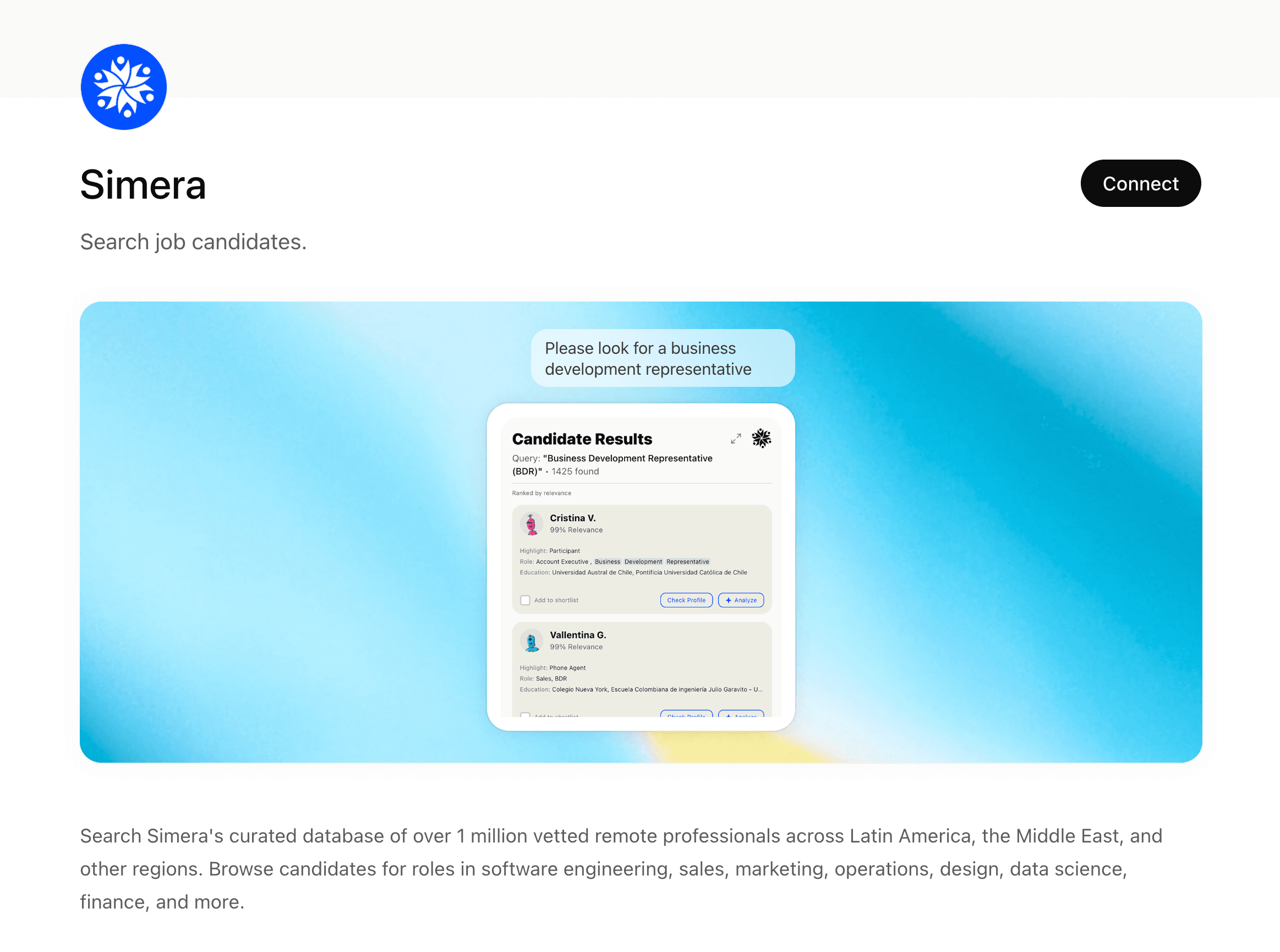
Customers browse the way they already know how, sorting and filtering the list themselves.
One app, three places it pays off
Simera did not build three products. They built one MCP app and pointed it at three surfaces.
Their customers' own agents. Simera ships Agent David as an app on the ChatGPT and Claude app stores (here is how we publish MCP apps to ChatGPT), so customers query Simera's talent pool directly. "I need a UX designer with Figma experience, full-time, in a European timezone" comes back as an interactive list they can work through without leaving the chat.
Their website. The same app is embedded at simera.io/agent-david, so visitors ask in plain language and get a structured answer instead of filling out a form. It runs on the same backend and data, available to anyone who does not use ChatGPT or Claude.
Their own operations team. Some requests still need a human's judgment. Those used to mean navigating the database by hand and wiring up complex custom filters to narrow the field. Now the team uses the same app, on their internal dashboard or in ChatGPT, then reviews and refines the results before sending.
Build once, deploy everywhere
Under the hood, Agent David is three pieces:
- The MCP server, which connects to Simera's candidate database and exposes the tools for searching and retrieving profiles.
- The MCP app, which renders those results as interactive components inside ChatGPT, Claude, or Simera's own site.
- Manufact Cloud, which turned what is traditionally a slow, complex deployment bottleneck into a fast, single-step launch. By handling hosting, auth, and observability out of the box, Manufact let Simera take Agent David from a
git pushstraight to production across all three surfaces at once.
The same MCP app drives customer self-service, the website, and internal tooling.
What's next
Simera is not stopping at search. On the roadmap: scheduling interviews through the agent, folding skill assessments into the selection flow, and personalizing results based on conversation history. All of it runs on the same foundation, mcp-use for the protocol and Manufact for deployment.
If you are sitting on structured data like candidates, products, or records, the same path is repeatable. Start with an MCP server to expose it, then move to an MCP app when text stops doing it justice, and reuse that app across chat, your website, and internal tools.
Thanks to the Simera team for building in the open with us.
Want to build your own MCP app? Start with the documentation or deploy in under 60 seconds at mcp-use.com. And try Agent David yourself at simera.io/agent-david.